
Costs & savings
How do solar panels cut your electricity bills?
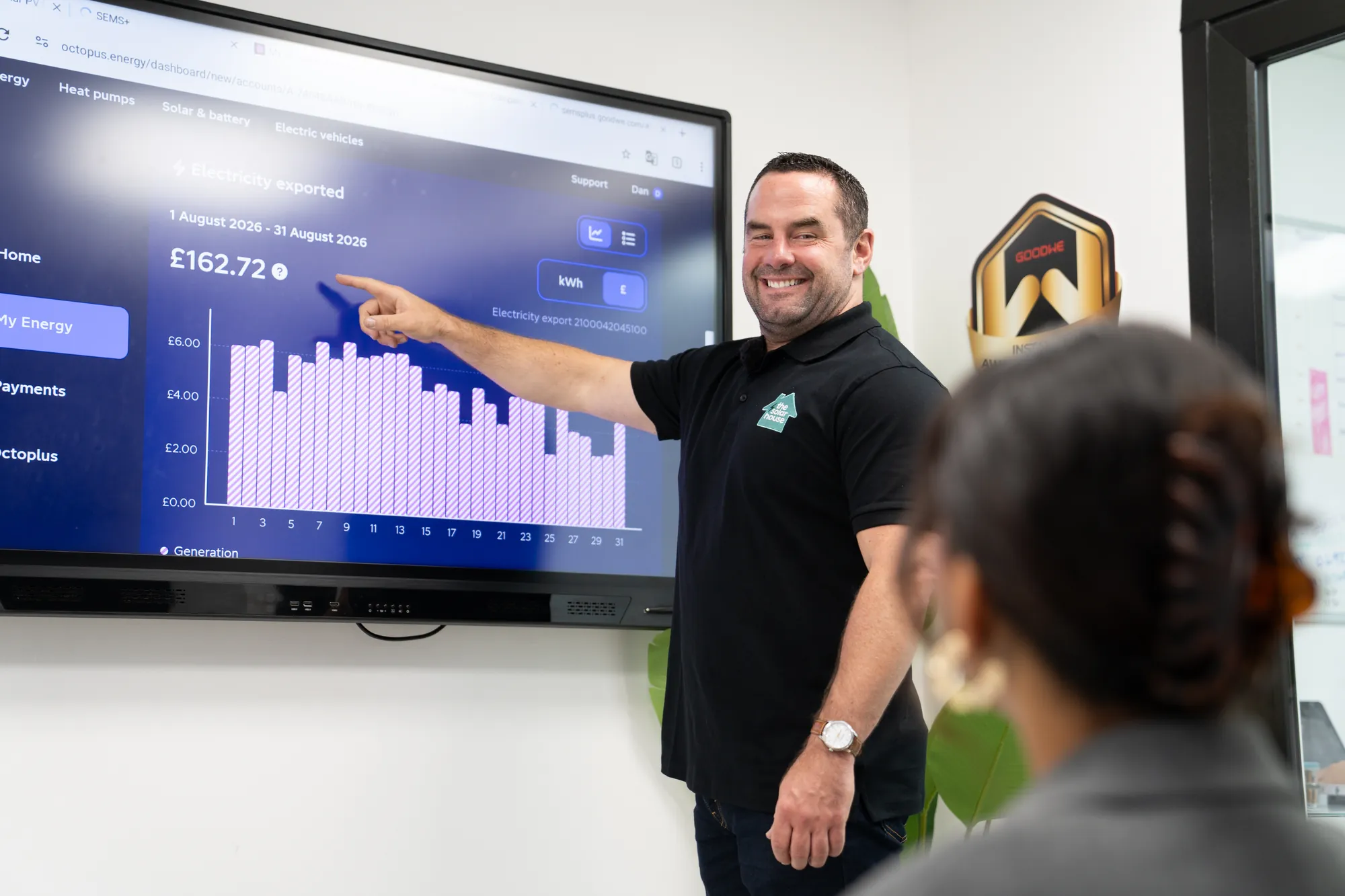
Solar panels cut your electricity bill mainly by powering your home directly, so you buy fewer units from the grid. Any electricity you don't use is exported, and under the Smart Export Guarantee a supplier pays you for it at a rate it sets. How much you save depends on how much your panels generate, how much of that you use yourself, and the prices on your import and export tariffs.
- Under the MCS installation standard, estimated annual output is worked out as kWp × Kk × SF: system size, a location and roof-angle factor, and a shading factor (MCS MIS 3002, Issue 6.0, Appendix B).
- MCS certified installers must give you a generation estimate and a self-consumption estimate before you sign, with a note that neither is a guarantee (MIS 3002, section 4.1).
- MCS's self-consumption method, MGD 003, uses your yearly generation, your yearly electricity use, when you're usually at home and, if you have one, your battery's usable capacity (MCS MGD 003, Issue 2.0).
- In one MGD 003 worked example, a home using 3,879 kWh a year with 4,059 kWh of solar self-consumes 29% without a battery and 69% with a 7.5 kWh usable battery (MGD 003, Table 6-1).
- Electricity suppliers with at least 150,000 domestic customers must offer a Smart Export Guarantee tariff, and the rate must always be above zero (Ofgem).
Where do the savings actually come from?
There are two parts to it.
- Using your own solar electricity. Every unit your panels generate and your home uses at the same moment, or later from a battery, is a unit you don't buy from your supplier. MCS calls this self-consumption: the share of your solar electricity that is used in your home rather than exported.
- Getting paid for what you export. Surplus electricity flows out to the grid. Through the Smart Export Guarantee (SEG), a supplier you choose pays you for each exported unit. You need an MCS certificate (or an equivalent) and a meter that records exports.
A unit you use yourself saves you the price on your import tariff. A unit you export earns you your SEG rate. Comparing those two numbers on your own bill and export offer shows you how much more each self-consumed unit is worth to you than each exported one.
What affects how much you save?
Four things matter most:
- How much your panels generate. This depends on the system's size in kilowatts peak (kWp), where you live, the roof's pitch and direction, and shading.
- How much electricity you use in a year.
- When you use it. Solar generates in daylight, so a home that's occupied during the day tends to use more of it directly.
- Your tariffs. Your import unit price, any time-of-use rates, and your SEG export rate.
Every roof is different. For example, one 4.2kWp, nine-panel system we designed in Newport faces south but is partly shaded by neighbouring buildings, so its MCS estimate is 3,170 kWh a year. A 6.75kWp system spread across three roof faces in Cardiff has an MCS estimate of 5,190 kWh a year. These are single homes' estimates, not typical figures.
How does MCS estimate how much your panels will generate?
MIS 3002 is the MCS standard for installing solar PV. Appendix B sets out a standard method. The installer:
- adds up the rated output of every panel to get the system's kWp;
- finds your postcode zone;
- measures the pitch and orientation of each roof face;
- looks up a figure called Kk (kWh per kWp) from the table for that zone, pitch and orientation;
- works out a shade factor (SF) from anything blocking the horizon, such as chimneys, trees or neighbouring buildings.
Estimated annual output is then kWp × Kk × SF. MIS 3002 requires the installer to tell you that the estimate is guidance only for the first year of generation and isn't a guarantee of performance. Where shading is present and the MCS shading method is used, the standard's wording says the result is expected to be within 10% of the estimate for most systems.
How does MCS estimate how much of it you'll use?
MIS 3002 requires the self-consumption estimate to be calculated using MGD 003: Solar PV Self-Consumption. It is a set of look-up tables based on research by Loughborough University, Advance Further Energy and BRE National Solar Centre. The installer needs:
- Your yearly generation, from the MIS 3002 method above.
- Your yearly electricity use, ideally from 12 months of bills. If that isn't available, MGD 003 uses 3,500 kWh.
- Your occupancy pattern, chosen by asking you: "home all day" (someone in between 9am and 5pm on weekdays), "in half the day", or "out all day". If it isn't known, the "in half the day" table is used.
- Your battery's usable capacity, if you're having one.
A few limits are worth knowing. The method is for homes using between 1,500 and 6,000 kWh a year, with solar generation below 6,000 kWh a year. It doesn't count the extra self-consumption from heat pumps, electric heating, hot water diverters or electric vehicles. Self-consumption is capped at 95% of generation. MCS also says the figure is an average for similar homes, not a prediction for yours, and that it applies to the first year.
Your quote should also show grid independence (also called self-sufficiency). That's a different measure: the share of your home's total electricity use that is covered by your own solar. Self-consumption, by contrast, is the share of your solar that you use.
How does a battery change the numbers?
Without a battery, solar you can't use straight away is exported. A battery stores that surplus and releases it in the evening or overnight, so more of your solar is used at home.
MGD 003's two worked examples show the effect:
- A "home all day" household using 3,879 kWh a year, with 4,059 kWh of solar: self-consumption rises from 29% to 69% with a 7.5 kWh usable battery. Grid independence rises from 30% to 72%.
- An "in half the day" household using 5,783 kWh a year, with 2,456 kWh of solar: self-consumption rises from 39% to 88% with a 5.1 kWh usable battery. Grid independence rises from 17% to 37%.
These are MCS's illustrations, not predictions for any particular home. MGD 003 uses the battery's usable capacity, minus anything kept in reserve for backup: if 20% is reserved, only 80% counts. You can read more on our battery storage page.
Where do time-of-use tariffs fit in?
GOV.UK describes time-of-use tariffs as tariffs where the unit cost of electricity changes with the time of day, with cheaper rates at off-peak times such as overnight. With a battery, you can charge from the grid when it's cheap and use that stored electricity when prices are higher.
There's a trade-off. MGD 003 assumes the battery mainly stores solar. It notes that other modes, such as time-of-use charging or keeping a backup reserve, can reduce the self-consumption benefit, and says the installer should calculate and clearly explain that effect. If your battery charges from the grid and also exports, Ofgem's SEG guidance says a supplier isn't obliged to pay SEG on export that may include grid electricity. It can choose to pay on all of it, none of it, or use extra metering or estimates. Check with your export supplier before you set up grid charging.
How can you use more of your own solar?
Moving flexible jobs into daylight hours helps, such as running the dishwasher or washing machine on a timer around midday. Charging an electric car from surplus solar also helps, and because MGD 003 leaves EV charging out, that gain sits on top of your MCS estimate. Read more about home EV chargers.
Why every quote should show its working
Every quote we give includes an MCS-method generation estimate. MGD 003 says these standard figures are a fair basis for comparing offers from different installers or system sizes. If a quote also shows a figure from other software, MIS 3002 says it mustn't be more prominent than the MCS estimate and should carry a warning if it's much better.
If you'd like to see how the numbers work for your roof and your bills, you're welcome to visit one of our showrooms or look through our FAQs. There's nothing to sign on the day.
Questions people ask
Do solar panels still save money if I'm out all day?
Yes, but you'll typically use less of the solar yourself and export more. MCS's self-consumption method has a separate 'out all day' table for this reason. A battery lets you store daytime solar for the evening. Your MCS estimate will show the figures for your situation.
What is the difference between self-consumption and grid independence?
Self-consumption is the share of your solar generation that you use at home. Grid independence (or self-sufficiency) is the share of your total electricity use that your solar covers. MCS requires both to be shown on your estimate.
Is the MCS estimate a guarantee?
No. MIS 3002 requires installers to state that the estimate is guidance for the first year of generation and not a guarantee of performance, because sunshine varies by location and from year to year.
Does the MCS self-consumption figure include my electric car or heat pump?
No. MGD 003 doesn't count extra self-consumption from heat pumps, electric heating, diverters or EV charging, so using solar for those would be on top of the estimate.
Can I charge my battery from the grid on a cheap overnight rate?
Often, yes, depending on your battery and tariff. It can reduce the self-consumption benefit, and if grid-charged electricity is later exported, your SEG supplier may treat that export differently. Check with your export supplier first.
Sources
- MIS 3002 The Solar PV Standard (Installation), Issue 6.0 (18/03/2026) MCS, checked 12 October 2026
- MGD 003 Solar PV Self-Consumption, Issue 2.0 MCS, checked 12 October 2026
- PV Self-Consumption Guidance listing (MGD 003 v2.0, issue date 27/04/2022) MCS, checked 12 October 2026
- Smart Export Guarantee: electricity suppliers Ofgem, checked 12 October 2026
- Smart Export Guarantee (SEG) Ofgem, checked 12 October 2026
- SEG: Guidance for Generators (December 2019) Ofgem, checked 12 October 2026
- Smart Export Guarantee GOV.UK, checked 12 October 2026
- Your energy bill from April: what's changing (25 February 2026) GOV.UK (DESNZ), checked 12 October 2026