
Batteries
How does a home battery work with solar panels?
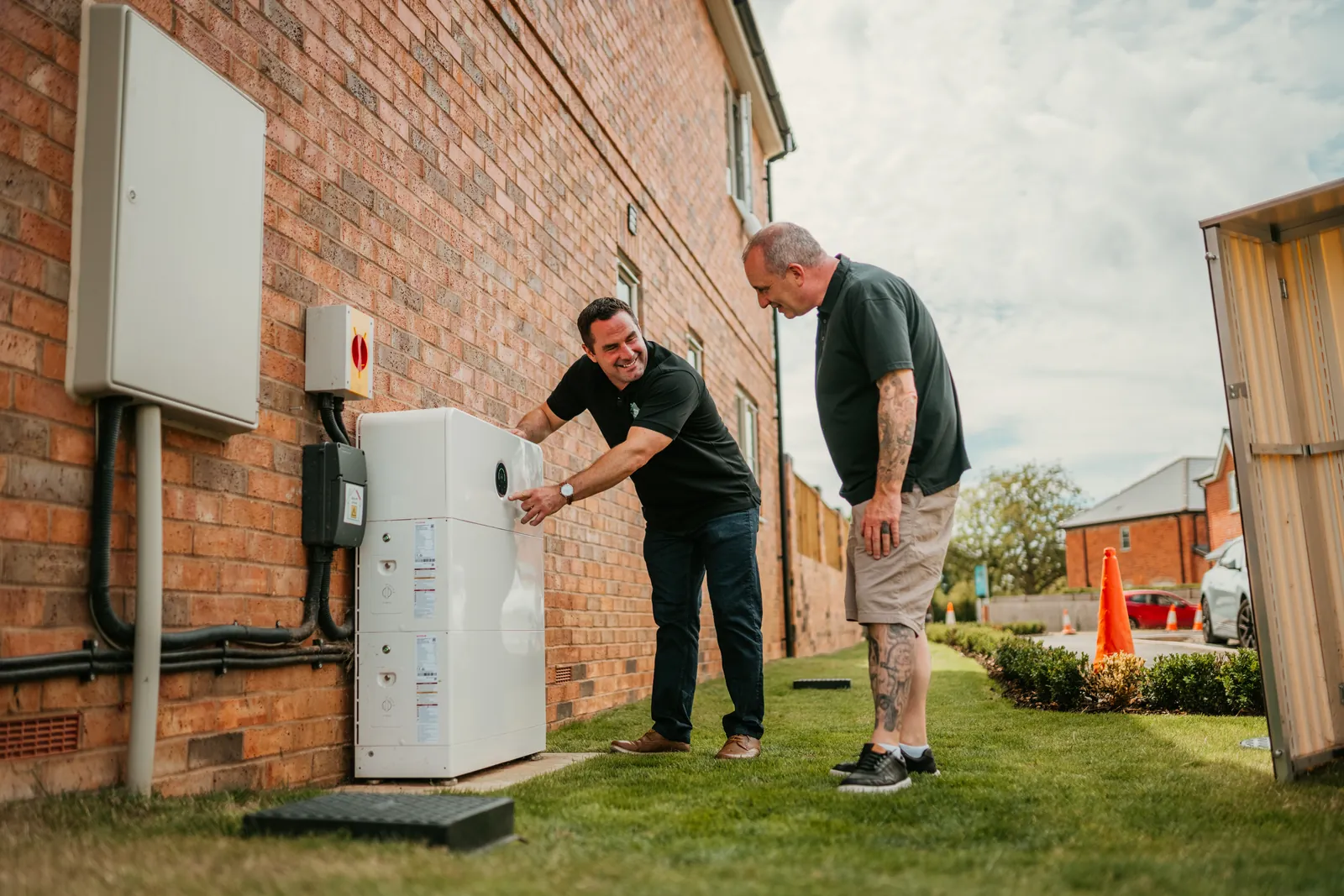
A home battery stores the solar electricity your panels make during the day that you don't use straight away, so you can use it in the evening instead of buying it from the grid. It can also charge from the grid at cheaper times if you're on a time-of-use tariff. How much it helps depends on its usable capacity, its efficiency, how it's connected, and when your household uses electricity.
- Tesla's 2026 UK datasheet lists Powerwall 3 at 13.5 kWh of usable energy and 89% solar-to-battery-to-home efficiency.
- GoodWe lists each Lynx Home D module (LX D5.0-10) at 5 kWh of usable energy.
- HMRC says that from 1 February 2024, batteries installed in homes qualify for the zero rate of VAT, including a battery retrofitted to existing solar panels.
- MCS says its self-consumption figure is an average for similar homes, not a performance prediction for your property.
- Running your home through a power cut needs extra islanding hardware. For Powerwall 3, Tesla lists Backup Gateway 2 as the supported islanding device.
How does a battery work with solar panels?
During the day, your home uses solar electricity first. Anything left over charges the battery instead of being exported. In the evening, when the panels stop producing, the battery supplies your home until it reaches its lower limit. Then you're back on the grid. If the battery is full and the panels are still producing more than you're using, the surplus is exported, as it would be without a battery. The Energy Saving Trust describes it the same way: the battery shifts when you use electricity so it lines up with when solar is free or grid power is cheap.
What's the difference between AC-coupled, DC-coupled and hybrid systems?
Solar panels make direct current (DC). Your home runs on alternating current (AC). An inverter converts one to the other. The coupling describes where the battery joins the system.
- DC-coupled (hybrid inverter): the panels and battery share one inverter. MCS's battery standard, MIS 3012, covers batteries connected to the DC terminals of an inverter that is also serving solar PV. GoodWe's Lynx D, for example, is a high-voltage battery made to work with GoodWe's own energy storage inverters.
- AC-coupled: the battery has its own inverter and connects to your home's wiring, alongside a separate solar inverter. Tesla's Powerwall 3 datasheet shows this as a configuration where Powerwall 3 is used for storage only and a separate inverter handles the panels.
- All-in-one: Powerwall 3 also has a built-in solar inverter with three MPPT inputs and up to 20 kW of solar input, so it can act as the hybrid inverter in a new system.
Which suits you depends on the equipment you already have and what you want the battery to do. Under MCS 032, the MCS pre-sale standard, an installer must tell you in writing, before you sign, whether the battery is AC or DC coupled and whether it uses an existing inverter.
What's the difference between usable and nominal capacity?
Nominal capacity is the total energy the cells can hold. Usable capacity is what you can actually take out in normal use. MCS 032 requires installers to state the usable storage capacity in kWh, accounting for the maximum allowable depth of discharge, so compare usable figures when you look at quotes.
Tesla's 2026 UK datasheet gives Powerwall 3 a usable battery energy of 13.5 kWh, which it says is the minimum guaranteed at beginning of life, at 25°C and 5 kW charge and discharge. GoodWe's Lynx D datasheet lists 5 kWh usable per module, tested at 100% depth of discharge at beginning of life, and notes that usable energy may vary with different inverters.
Capacity also fades with age. Tesla's UK warranty guarantees 80% energy retention at 10 years.
What is round-trip efficiency?
Some energy is lost every time a battery charges and discharges. Tesla's datasheet lists Powerwall 3 at 89% solar-to-battery-to-home efficiency, compared with 97.5% when solar goes straight to your home or the grid. Using Tesla's 89% figure, 10 kWh of solar stored in the battery would give back about 8.9 kWh. The Energy Saving Trust makes the same general point: using stored energy is less efficient than using electricity directly from your panels or the grid.
MCS's estimate method assumes a battery with a round-trip efficiency of at least 80% at 25°C. MCS 032 also requires installers to tell you the round-trip efficiency, and the energy lost if you charge from the grid.
What size battery do I need?
Look at how much electricity you use after the sun goes down, not your total daily use. A battery only saves what it can fill from surplus solar (or cheap grid power) and then empty again. The Energy Saving Trust says a typical home system might be 10 kWh, but there's no exact formula.
MCS's method estimates self-consumption from your annual solar generation, your annual electricity use, when you're usually at home (home all day, home half the day, or out all day) and the battery's usable capacity. MCS says it can be used as a sense check on battery size, but it isn't a design or sizing tool. In MCS's own worked example, a 3 kWp system making 2,775 kWh a year, in a home using 3,500 kWh that is occupied half the day, uses 29% of its solar on site without a battery. With 9 kWh of usable storage, that rises to 82%. These figures come from MCS's example, not from a real home.
Power matters as well as capacity. A Lynx D module has a nominal power of 3 kW. Powerwall 3 can charge at up to 5 kW on its own, or 8 kW with Expansion units.
Can a battery charge from the grid on a cheaper tariff?
Yes, if the system supports it. The Energy Saving Trust notes that a battery can be charged when a smart time-of-use tariff is cheap and used when prices are high, with or without solar panels. MCS 032 requires installers to tell you whether the battery can respond to time-of-use tariffs, and whether that is a manual setting or happens automatically. MCS also says that charging from the grid can reduce how much of your own solar the battery stores, and that installers should explain the effect.
Will a battery keep my lights on in a power cut?
Not automatically. To run during an outage, the system has to disconnect safely from the grid and create its own supply, which is called island mode. MIS 3012 sets out how this must be done, including an isolator that separates the backed-up part of your home from the grid and a safe earthing arrangement. For Powerwall 3, Tesla's datasheet lists Backup Gateway 2, which detects an outage, controls the grid connection and provides backup power to either the whole home or selected circuits. Before you sign, an installer must tell you whether the system can run in island mode and the maximum load it can supply.
Can I add a battery to my existing solar panels?
Yes, if it's compatible. MCS says a certified installer can connect a battery to an existing system, as long as it's compatible. MCS's self-consumption method applies to retrofits as well as new systems. Your installer must also notify the local network operator. MIS 3012 gives the example that a 3 kW solar system and a 3 kW battery on the same single-phase supply together exceed 16 A, so the G99 process applies rather than the simpler G98.
Is VAT charged on a home battery?
HMRC says that from 1 February 2024, electrical storage batteries installed in residential accommodation qualify for the temporary zero rate of VAT. That covers a battery retrofitted to existing solar panels and a standalone battery that stores grid electricity. The zero rate on energy-saving materials runs until 31 March 2027, and HMRC says the reduced rate applies after that. A battery supplied without installation is standard-rated.
Every home is different, so the best next step is a conversation. You can read more about battery storage, visit one of our showrooms to see a battery set up, or ask the team a question.
Questions people ask
How long does a home battery last?
The Energy Saving Trust puts the typical lifespan at about 10 to 12 years, which is shorter than solar panels. Tesla's UK warranty for Powerwall 3 runs for 10 years and guarantees 80% energy retention at 10 years.
Do I need solar panels to have a battery?
No. The Energy Saving Trust says a battery can be charged on a cheap time-of-use rate and used when prices are higher. HMRC says a standalone battery that stores grid electricity also qualifies for the zero rate of VAT when it's installed in a home.
Is a bigger battery always better?
Not necessarily. A battery only saves what it can fill and use again. MCS says its self-consumption method can be used as a sense check on size, and your installer should base the size on your evening and overnight use.
Will I get an estimate of what the battery will do?
Yes. Under MCS 032, an MCS installer must give you a performance estimate before you sign. MCS says the estimate is guidance only and should not be considered a guarantee of performance.
Sources
- Powerwall 3 Datasheet (UK, 2026) Tesla, checked 12 October 2026
- Powerwall Limited Warranty (EMEA), Rev. 1.16, effective 3 December 2025 Tesla, checked 12 October 2026
- Lynx Home D Series datasheet (LX D5.0-10), GoodWe-Single page-20250401-EN-V2.1 GoodWe (manufacturer datasheet, hosted by Solarproof), checked 12 October 2026
- MIS 3012:2025 Battery: Installation Standard, Issue 1.0 (01/01/2025) MCS, checked 12 October 2026
- MCS 032:2025 Solar PV & Battery: Pre-Sale Information and System Performance Estimate Standard, Issue 1.0 MCS, checked 12 October 2026
- VAT on energy-saving materials and heating equipment (VAT Notice 708/6) HMRC (GOV.UK), checked 12 October 2026
- Battery storage (last updated 6 October 2026) Energy Saving Trust, checked 12 October 2026
- Battery Storage – consumer technology page MCS, checked 12 October 2026