
Solar
Do solar panels work in winter and on cloudy days in the UK?
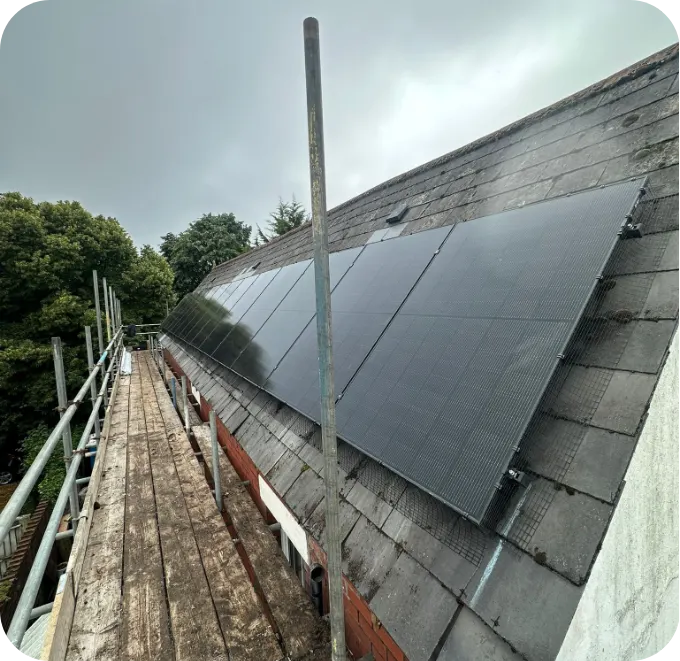
Yes. Solar panels generate electricity all year in the UK, including on cloudy days, because they use daylight rather than direct sunshine. They produce much less in winter, though. For a south-facing system in Cardiff, the European Commission's PVGIS model puts December at about 3% of the year's output, against about 13% in May. Cold weather slightly helps panel efficiency, while snow stops generation until it clears.
- The Energy Saving Trust says solar cells don't need direct sunlight and can work on cloudy days (Energy Saving Trust).
- At the Met Office's Cardiff Bute Park station, average sunshine for 1991–2020 was 50.44 hours in December and 199.56 hours in July (Met Office).
- In PVGIS's model of a south-facing, 35° system in Cardiff, December produces about 3.1% of the yearly total and November to February together about 16% (PVGIS, European Commission JRC).
- PVGIS data for Cardiff shows diffuse light makes up about two-thirds of the sunlight reaching the ground in December and about half in June (PVGIS).
- LONGi's datasheet for the EcoLife (LR7-54HVB) panels we fit gives a power temperature coefficient of −0.26% per °C, measured from a standard cell temperature of 25°C (LONGi datasheet).
- The MCS estimate on a solar quote is a yearly figure for the first year, given as guidance and not a guarantee (MCS MIS 3002).
Do solar panels work on cloudy days?
They do, at a lower output. Sunlight reaches your roof in two ways. Direct light comes in a straight line from the sun. Diffuse light has been scattered by cloud and the atmosphere and arrives from across the whole sky. Panels convert both. The Energy Saving Trust says solar cells don't need direct sunlight and can work even on cloudy days, although the stronger the sunshine, the more electricity they make.
Diffuse light is a big share of what reaches British roofs. In the European Commission's PVGIS data for Cardiff (averaged over 2005–2023), diffuse light makes up about 48% of the sunlight reaching a horizontal surface in June and about 66% in December. On a heavily overcast day, output can be a small fraction of what the same panels produce in bright sun. Over a whole year, though, cloudy-day generation adds up.
How much less do solar panels generate in winter?
A lot less. That's down to shorter days, a lower sun and more cloud. The Met Office's 1991–2020 averages for Cardiff Bute Park show 50.44 hours of sunshine in December and 53.53 in January, against 195.21 in June and 199.56 in July.
To show the monthly pattern, we used PVGIS, the European Commission tool whose data also underpins the MCS estimate tables. We modelled 1kWp of south-facing panels at 35° in Cardiff with PVGIS's default 14% system losses. Here's each month's share of the yearly total:
- December: 3.1% (about 1.0 kWh per kWp a day)
- January: 3.5%
- February: 5.2%
- November: 4.1%
- March and October: 8.6% and 6.3%
- May, June and July: 12.7%, 12.6% and 12.4% (June averages about 4.4 kWh per kWp a day)
So November to February together produce about 16% of a typical year's electricity, and a December day averages roughly a quarter of a June day. Individual days vary much more than this. A clear, frosty day in January can beat a dull day in June.
Does cold weather affect solar panel efficiency?
Cold weather slightly helps panel efficiency. Panels are rated at a standard cell temperature of 25°C, and their output changes with temperature by an amount set out on the manufacturer's datasheet. For example, the datasheet for the LONGi EcoLife panels we fit gives a temperature coefficient for maximum power of −0.26% per °C. That means output falls by 0.26% for every degree the cells run above 25°C, and rises slightly when they're cooler.
Cells run warmer than the air around them. The same datasheet gives a nominal operating cell temperature of 45°C under its test conditions. At 45°C, the coefficient points to about 5% less output than the panel's rated power. On a bright, cold winter day the cells stay cooler, so they work a little more efficiently. That doesn't make up for the weaker winter sun, but it's one reason clear winter days can be productive.
What happens to solar panels when it snows?
Snow lying on the panels blocks the light, so generation drops to little or nothing until it slides off or melts. Panels are tilted and have smooth glass, which helps, but how quickly they clear depends on the weather.
Please don't climb onto the roof or use a ladder to clear snow. MCS warns about the dangers of working at height, and its maintenance schedule only asks homeowners to make visual checks from the ground. That includes looking for signs of structural distress, particularly after heavy snow.
Snow loading is part of the design. Panels are tested for load: the LONGi datasheet above lists a front-side maximum static load of 5,400 Pa. The MCS installation standard also requires a structural engineer for roofs where snow can build up, such as those with dormers, valleys or parapets. It also says panels near roof edges need measures so that sliding snow can't cause injury or damage.
How does the MCS estimate account for winter?
The MCS estimate on your quote is an annual figure. It's calculated as system size (kWp) × a kWh-per-kWp value for your postcode zone, orientation and pitch × a shade factor. Those kWh-per-kWp values come from PVGIS data multiplied by 0.8. The standard method gives one yearly total rather than a month-by-month profile, so winter is already built into the annual number.
MCS requires every estimate to say it is guidance for the first year of generation only and not a guarantee, because sunlight varies from place to place and from year to year. A dull winter or a bright one will move your real figures either way. If you'd like to see how your system's output might spread across the months, ask us when we prepare your quote.
What does winter mean for a home battery?
In summer, a battery mostly stores surplus solar for the evening. In winter there's much less surplus. At about 1 kWh per kWp a day in December in the Cardiff model above, a 4kWp system would average about 4 kWh a day. For comparison, MCS's worked example assumes a home using 3,500 kWh a year, which is about 9.6 kWh a day. Most winter solar is likely to be used in the house as it's generated, with little left to store.
That's why many batteries are also used with a time-of-use tariff. The Energy Saving Trust explains that a battery can be charged when the tariff is cheap and the stored energy used when prices are higher. It also notes that a battery's system stops discharging at a set level, perhaps 20%, to protect its life. Whether this works for you depends on your tariff and usage, so we'll go through it with you rather than assume. Read more about home battery storage.
Do I need to do anything to my panels in winter?
Very little. The Energy Saving Trust says rain will clean panels tilted at 15 degrees or more. MCS's maintenance schedule suggests homeowners check from the ground that the panels haven't slipped or been damaged and that recorded generation keeps increasing. If your monitoring shows nothing at all on a bright day once any snow has cleared, contact your installer.
If you'd like to see what solar could produce on your roof through the year, visit one of our showrooms or read more about our solar panels.
Questions people ask
Do solar panels work in winter in the UK?
Yes, but at a much lower output. In the European Commission's PVGIS model of a south-facing system in Cardiff, December produces about 3% of the year's electricity and November to February together about 16%.
Do solar panels work on cloudy days?
Yes. The Energy Saving Trust says solar cells don't need direct sunlight and can work on cloudy days. They use diffuse light scattered by cloud, which PVGIS data shows is around half or more of the sunlight reaching the ground in Cardiff.
Are solar panels less efficient in the cold?
No, they're slightly more efficient when cold. Output falls as cells heat up. One LONGi datasheet gives −0.26% per °C above 25°C, so cool, bright days help. Winter output is lower because of shorter days and a lower sun, not the cold.
Should I clear snow off my solar panels?
No, don't go on the roof or use a ladder. Snow usually slides off or melts. MCS only asks homeowners to make visual checks from the ground, including for signs of structural distress after heavy snow.
Is a battery worth having in winter?
There's less spare solar to store in winter. The Energy Saving Trust explains that a battery can also be charged on a cheap time-of-use rate and used when prices are higher. Whether that suits you depends on your tariff and usage.
Sources
- Solar panels: costs, savings and benefits explained (last updated 1 October 2026) Energy Saving Trust, checked 12 October 2026
- Battery storage (last updated 6 October 2026) Energy Saving Trust, checked 12 October 2026
- Cardiff, Bute Park location-specific long-term averages (1991–2020) Met Office, checked 12 October 2026
- PVGIS (Photovoltaic Geographical Information System) v5.3 - grid-connected PV calculation, Cardiff 51.48N 3.18W, 1kWp, 35°, south, 14% loss, PVGIS-SARAH3 2005–2023 European Commission Joint Research Centre, checked 12 October 2026
- PVGIS v5.3 - monthly radiation with diffuse-to-global ratio, Cardiff, 2005–2023 European Commission Joint Research Centre, checked 12 October 2026
- EcoLife LR7-54HVB 475–495M datasheet (BGV02, 2025-08-20) LONGi, checked 12 October 2026
- MIS 3002 The Solar PV Standard (Installation), Issue 6.0 (18/03/2026) MCS, checked 12 October 2026
- MCS 032:2025 Solar PV & Battery: Pre-Sale Information and System Performance Estimate Standard, Issue 1.0 MCS, checked 12 October 2026
- MGD 005 Solar PV Shade Evaluation Procedure (health warning on working at height) MCS, checked 12 October 2026