
EV charging
How does home EV charging work?
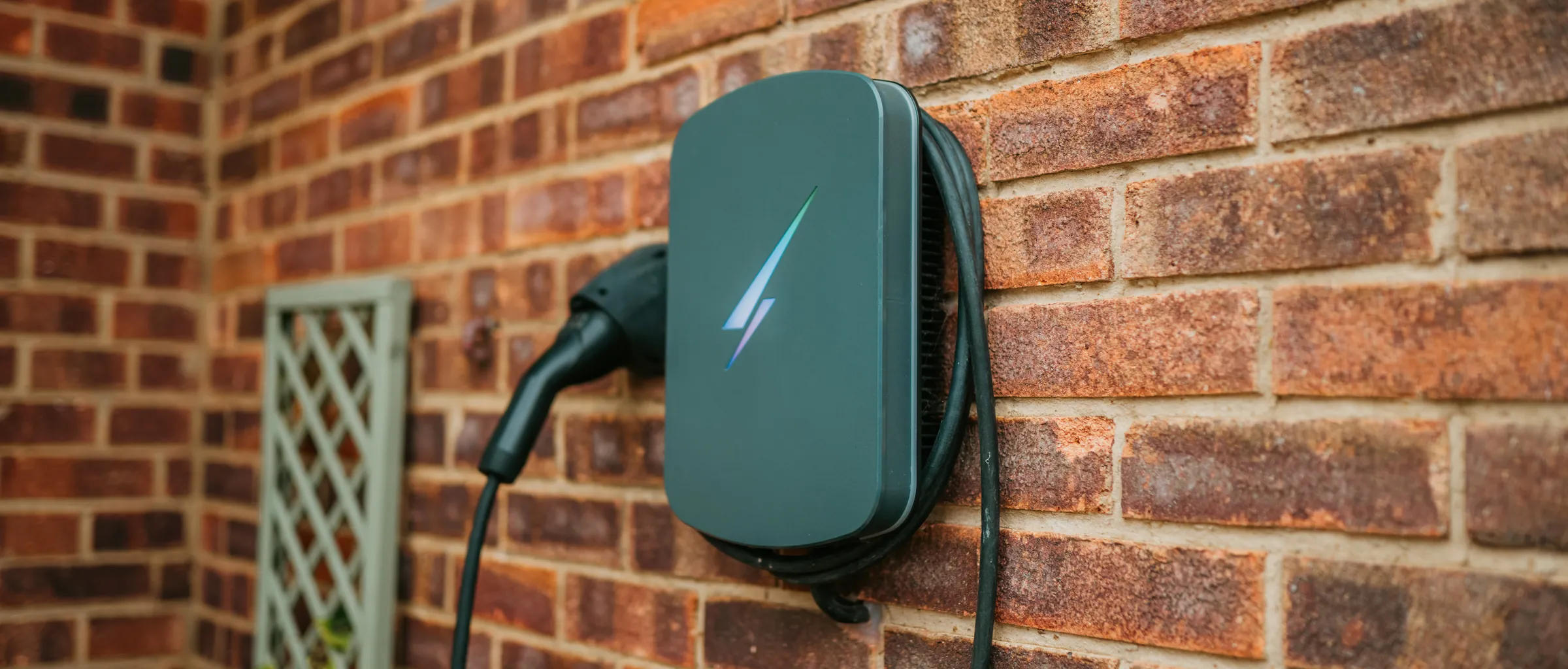
A home EV charger is a fixed unit, usually on an outside wall near where you park, wired back to your consumer unit. Typical home chargers are rated up to about 7kW on a normal single-phase supply, and since 30 June 2022 every new home charger sold in Great Britain has had to be a smart charger by law. Before one is fitted, your installer checks your supply and earthing, and your local electricity network operator has to be told.
- Since 30 June 2022, private home and workplace charge points sold in Great Britain must meet The Electric Vehicles (Smart Charge Points) Regulations 2021.
- They must come with pre-set default charging hours outside peak times (8am to 11am and 4pm to 10pm on weekdays), which you can accept, change or remove.
- The Energy Networks Association says the network operator must be informed of every EV charger installation.
- The government's EV chargepoint grant gives flat owners and renters with private off-street parking 75% off, up to £500. The scheme closes on 31 March 2027.
- The Energy Saving Trust's rule of thumb is that a 7kW charger adds roughly 7 miles of range for every 20 minutes of charging.
What size charger do I need?
The Energy Saving Trust groups chargers by power. Standard chargepoints, from 3.7kW to just under 8kW, take five and a half to 11 hours for a full charge. Low-speed charging below 3.7kW takes 12 to 15 hours. A typical home charger such as the Hypervolt Home 3 Pro is rated at 7.4kW and 32A on a single-phase 230V supply.
Your car has a say too. The Energy Saving Trust points out that some chargepoints provide more power than a car can accept, and then the car's own charge rate sets the speed. By its figures, a 7.4kW charger takes about 7 hours 45 minutes to charge a 50kWh battery from 20%, or about 10 hours for a 75kWh battery.
What connector will my charger have?
Home chargers come tethered (with a cable fixed to the unit) or untethered (you plug in your own cable). The Hypervolt Home 3 Pro, for example, is tethered and comes with either a Type 2 or a Type 1 connector. Check whether your car has a Type 2 or Type 1 socket before you choose.
What does the law say a smart charger must do?
The Electric Vehicles (Smart Charge Points) Regulations 2021 apply to private charge points sold in Great Britain from 30 June 2022, including in Wales. They don't cover rapid chargers of 50kW or more or public chargers. GOV.UK guidance sets out the main requirements. A charger must:
- send and receive information, and be able to change how fast or when it charges in response to signals (known as demand side response)
- keep its smart functions if you change electricity supplier
- keep charging your car if it loses its internet connection
- measure the electricity used and charging time, and let you see it for each session, each month and the past 12 months
- come with pre-set default charging hours outside weekday peak hours of 8am to 11am and 4pm to 10pm, which you can accept, change or remove
- apply a random delay of up to 600 seconds at the start of charging, which you can cancel
- meet security requirements, which took effect on 30 December 2022
In practice, your charger will usually be set to charge outside busy times unless you choose otherwise, and you can override it whenever you need to.
What happens when a charger is installed?
Before installing, an installer looks at whether your supply can take the extra load, the condition of the main fuse and cut-out, the best spot for the charger and cable, and the earthing. The Energy Networks Association lists supply overload, damage to supply equipment, power quality and the adequacy of earthing as reasons the network operator may need to be contacted before the work goes ahead.
The network operator must be told about every installation. For homes where the new maximum demand will be between 60A and 100A, the ENA says the installer must apply before installing, and the network operator will confirm within 10 working days whether the charger can be connected. The Energy Saving Trust notes that your installer will usually register the charger with the network operator for you.
What is PME earthing and why does it matter?
PME (protective multiple earthing) is one of the earthing arrangements used to supply homes. If a fault breaks the combined neutral and earth conductor in the street supply, metal parts connected to a PME earth can become live. That matters for a car parked outside on wet ground.
The IET explains that regulation 722.411.4.1 of BS 7671, the wiring regulations, does not allow PME to supply an outdoor EV charging point unless one of several measures is used. These include a very low resistance earth electrode, or a device that detects a broken conductor and disconnects the charger. Some chargers build this protection in. Hypervolt, for example, lists integrated PEN fault protection for the Home 3 Pro. Your installer will confirm which method applies to your home.
Can I get a grant for a home charger?
If you own and live in a flat, or rent and live in any home, you may qualify for the EV chargepoint grant. It gives 75% off the cost of buying and installing a socket, up to £500. The eligibility rules say you need private off-street parking that's clearly defined and that you can use at any time, and a vehicle on the list of approved electric vehicles. The scheme doesn't cover homeowners living in a house that hasn't been converted into flats.
The grant listing says you must use an OZEV-authorised installer and an eligible chargepoint. You apply first, then the installer claims the grant after installation and takes it off your invoice. The scheme closes on 31 March 2027, and the government can change or end it before then.
Can I charge my car from my solar panels?
Yes, with a charger that can follow your solar output. Hypervolt's charging modes are a good example. In its Super-Eco mode, the charger uses only solar and home battery energy and needs a surplus of about 1.4kW to start. In Eco mode, it keeps charging at a minimum of 1.4kW and uses all surplus solar up to 7.4kW. You can combine solar charging in the day with off-peak grid charging at night.
The car may not always be home when the sun is out, so solar won't cover all your charging. MCS's own guidance makes the same point. When an MCS installer estimates the extra solar you'll use for EV charging, the total self-consumption in the quote is capped at 95%. Read more about solar panels and battery storage if you're thinking about combining them.
How do tariffs fit in?
The Energy Saving Trust says your electricity bills will go up when you charge at home, so it's worth checking you're on the right tariff. EV and other time-of-use tariffs offer lower rates at certain times, often overnight, and a smart charger can be scheduled to use them. Some EV tariffs vary their cheap times, and these typically need a smart meter.
If you'd like to talk through what would suit your home and car, see our EV chargers page, book a showroom visit, or ask the team.
Questions people ask
Do I need off-street parking for a home charger?
Yes, in practice. The Energy Saving Trust says you'll need a driveway or garage to install a home chargepoint. The government grant also requires private off-street parking.
How long does it take to charge an EV at home?
It depends on the charger, the car and the battery size. The Energy Saving Trust's figures show a 7.4kW charger taking about 7 hours 45 minutes to charge a 50kWh battery from 20%.
Does a new home charger have to be a smart charger?
Yes. Private charge points sold in Great Britain since 30 June 2022 must meet The Electric Vehicles (Smart Charge Points) Regulations 2021.
Will my charger still work if the Wi-Fi goes down?
Yes. The regulations require a charger to keep charging your car if it loses its connection to the communications network.
Can I charge during peak hours if I need to?
Yes. Chargers come with default off-peak hours, but the regulations say you must be able to change or remove them and override the default when you need to.
Sources
- The Electric Vehicles (Smart Charge Points) Regulations 2021 (SI 2021/1467), as made legislation.gov.uk, checked 12 October 2026
- Regulations: electric vehicle smart charge points (last updated 23 April 2024) GOV.UK (OZEV), checked 12 October 2026
- Electric vehicle chargepoint grant for renters or flat owners GOV.UK, checked 12 October 2026
- Electric vehicle chargepoint grant – eligibility GOV.UK, checked 12 October 2026
- Electric vehicle chargepoint grant for renters and flat owners Find a grant (GOV.UK), checked 12 October 2026
- Electric vehicle chargepoint grants (last updated 1 April 2026) GOV.UK (OZEV), checked 12 October 2026
- Connecting electric vehicles and heat pumps to the networks Energy Networks Association, checked 12 October 2026
- Charging electric vehicles (last updated 23 April 2026) Energy Saving Trust, checked 12 October 2026
- BS 7671:2018+A1:2020 (Wiring Matters, Issue 79, March 2020) IET, checked 12 October 2026
- Home 3 Pro Technical Specification Hypervolt (manufacturer), checked 12 October 2026
- Hypervolt Charging Modes Hypervolt (manufacturer), checked 12 October 2026
- MCS 032:2025 Solar PV & Battery: Pre-Sale Information and System Performance Estimate Standard MCS, checked 12 October 2026